Why your AI agents need a memory layer (and why the model isn't the moat)
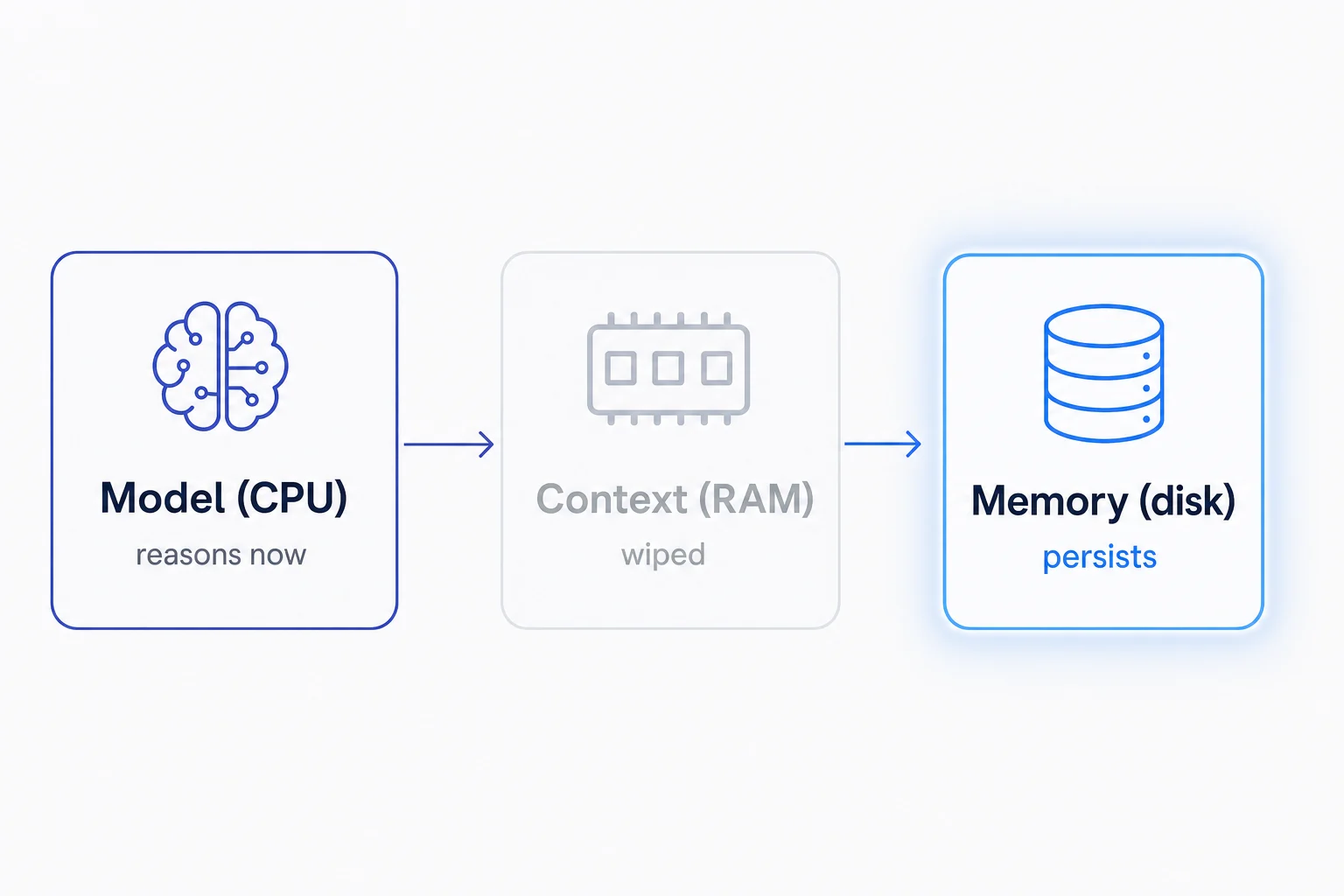
Karpathy framed LLMs as a new operating system: the model is the CPU, context is the RAM. But no serious computer ships without a disk. Persistent memory is the missing layer.
Building on LLMs today feels like programming against a CPU with no hard drive. Andrej Karpathy put it plainly in 2023: large language models behave like a new kind of operating system, where the model is the CPU and the context window is the RAM. The analogy is useful precisely for what it leaves out: persistent storage.
Without that layer, every run of your agent starts cold. You re-embed the same documents, re-stuff the same context into the prompt, and pay for the same tokens, over and over.
Context doesn't scale by stuffing everything into the prompt
The naive answer — "I'll put it all in context, we have millions of tokens now" — doesn't scale, for three reasons:
- Cost: refilling the window on every call scales token spend linearly with usage.
- Latency: giant prompts are slow prompts.
- Precision: more irrelevant context dilutes the model's attention. Retrieving the right thing beats retrieving everything.
What you need isn't a bigger context. It's selective retrieval of the right memory at the right time, with provenance.
The model isn't the moat
If your product depends on GPT being better than Claude this week, you don't have a moat: you have an integration. Models converge and become interchangeable. What is *not* interchangeable is the structured knowledge of your user's domain: their decisions, documents and history, connected in a graph of facts with citations.
That layer is model-agnostic by design. Swap providers and your memory is still there.
What MemoryFirst does
MemoryFirst is that memory layer, served as an API and an MCP implementation:
- Ingests emails, documents, calls, code and operational events and structures them into a fact graph.
- Retrieves with dense + BM25 + graph search, RRF fusion and cross-encoder reranking, and returns the answer with verifiable citations (the exact paragraph, minute, message).
- Stays current: contradicting information resolves toward the most recent truth instead of returning both versions.
- Model-agnostic: OpenAI-compatible API and an MCP server (stdio, HTTP, SSE), so any agent — Claude, Cursor, ChatGPT — can read it.
Models become interchangeable; what isn't, is the structured, verifiable knowledge of your business.
The AI-first pattern for developers
Building AI-first isn't bolting on a chat wrapper. It's designing your system to accumulate context instead of discarding it. You give the agent a disk: a persistent, auditable memory layer that's portable across models. The model is a commodity. The memory is yours.
Start with the docs or wire up the MCP server in an afternoon.
Give your agents a memory.
The memory layer for AI: OpenAI-compatible API + MCP, with citations and EU data.
Start free